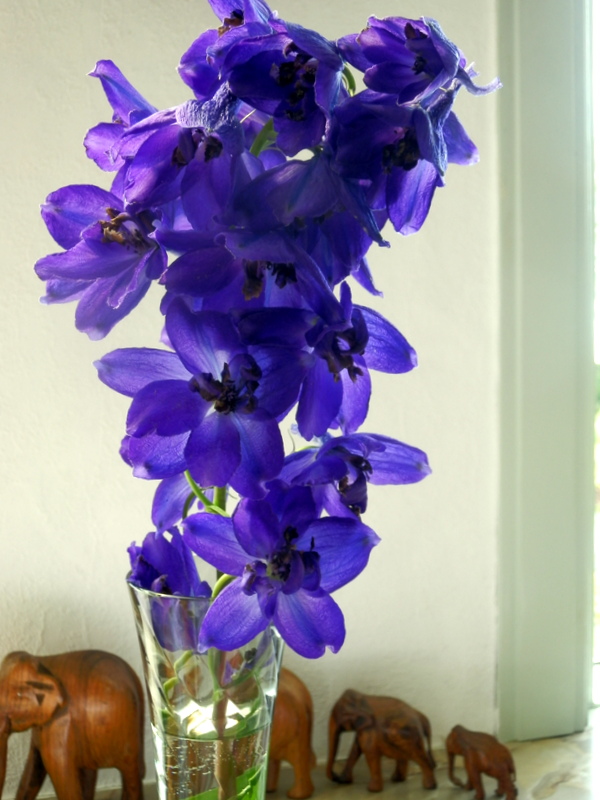
De Iris is een bloem die in bijna alle kleuren van de regenboog voorkomt. In de Griekse mythologie is Iris, godin van de regenboog, als de brug die de hemel met de aarde verbindt. Zij was de boodschapper tussen goden en mensen en werd, net als Hermes, meestal door Zeus of Hera uitgezonden om met haar gouden vleugels en soms gevleugelde voeten met grote snelheid bevelen naar de aarde te brengen. Zij koos dan de weg langs de regenboog, waarlangs de wind haar voortblies.
De symbolische betekenis van de Iris luidt dan ook : "Ik heb een boodschap voor jou".
The Iris is a flower found in almost every colour of the rainbow. In Greek mythology Iris, goddess of the rainbow, is like the bridge that connects heaven to earth. She was the messenger between gods and humans and was like Hermes, sent to earth by Zeus or Hera to bring orders at great speed with her golden wings and sometimes winged feet. She chose the way along the rainbow, the wind was blowing her along.
The symbolic meaning of Iris is therefore: "I have a message for you".
Er zijn heel veel soorten Irissen, die zich onderscheiden in bolgewassen en wortelstokgewassen.
De Irissen uit bollen, houden van droge grond, dit zijn o.a. de Iris reticulata die vroeg in het jaar bloeit en de Iris hollandica die eind mei bloeit.
Bekende Irissen uit wortelstokken zijn de Iris germanica (baardiris) en de Iris sibirica (Siberische Iris).
De Iris germanica komt oorspronkelijk uit het Middelandse zeegebied en groeit in elke doorlatende losgemaakte grondsoort. Heel belangrijk is een zonnige plek in de tuin anders kwijnen ze weg. Deze Iris moet oppervlakkig geplant worden, het beste is de bovenkant van de rhizomen (wortelstokken) niet te bedekken met aarde, zodat ze veel zon kunnen vangen en niet wegrotten.
Om deze Iris te laten groeien en bloeien is dus wel enige kennis en/of oplettendheid nodig, het is niet de gemakkelijkste.
De Iris sibirica is één van de gemakkelijkste Irissen voor de tuin. Het is een frivole tuinplant met grasachtig blad waarboven de bloemen op ranke stelen uitsteken. Ze groeien nagenoeg overal maar prefereren vochtige grond. Ze is een prima plant voor de gemengde border maar wordt ook vaak langs vijverranden gebruikt. Ze mag echter niet in het water staan.
There are many species of Irises, that are divided in bulb and rhizomes. The bulbs like a dry soil, for instance the early little Iris reticulata and the Iris hollandica flowering end of May.
In Dutch gardens most well known Irises from rhizomes are Iris germanica (bearded Iris) and Iris sibirica (Siberian Iris).
Iris germanica comes originally from the Mediterranean and grows in any drained and loosened soil. Very important is a sunny spot in the garden otherwise they are languishing. This Iris should be planted supervicial with the top of the rhizomes to the surface, so that they can catch a lot of sun and not rot away.
For growing and flowering this Iris some know how and attention is needed, it is not the easiest plant.
Opposite, Iris sibirica is one of the easiest Irises for the garden. It's a frivolus garden plant with grass-like leaves above which flowers protrude on slender stems. They grow almost anywhere but prefer moist soil. Iris sibirica is an excellent plant for the mixed border but is also often used along pond edges. However, they should not stand in the water.
In mijn tuin heb ik diverse Irissen staan die nu volop bloeien. De Iris sibirica doet het zoals gezegd overal en daarvan staan op verschillende plaatsen groepjes in de border. De Iris germanica is een lastpak in mijn meestal vochtige veengrond. Hiervan heb ik geen groepen, ze staan vooraan in de border of voor de heg en ik verplant of deel ze regelmatig zodat ze toch blijven voortbestaan en dat lukt aardig. Het is me echter niet gelukt om er de juiste namen van te onthouden, ik weet er nog maar enkele, foutje van me. De laatste keer dat ik een Iris germanica kocht is al meer dan acht jaar geleden, ik probeer ze te laten overleven en te laten bloeien, dat is het.

In my garden I have various Irises flowering at this moment. Iris sibirica is growing and blooming everywhere and are planted in groups in the border. Iris germanica is a troublemaker in my mainly wet soil. I have no groups of them, they are in the front of the border or the yew hedge and I transplant them regularly so that they remain and that works quite good. Problem is I have lost their names, I only remember some of them, my fault. Last time I bought an Iris germanica was already more than 8 years ago, I do my best to let them survive and have some nice flowers, that's it.
- Edith Wolford -
- Bleu de Gien -
- Orange Slices -
Al deze foto's zijn de laatste vijf dagen gemaakt en wat ik doe of waar ik ben, deze jongen is er altijd bij.
All these Iris photos I took the last five days and what I do or where I am, this boy is always with me.
De enige wilde soort in ons land is de Iris pseudacorus, Gele lis genoemd. Het schijnt dat ook deze plant wordt bedreigd met uitsterven en is beschermd. Bij ons aan de waterkant staan er echter genoeg.
Grappig om te weten: Louis XVII liet in de twaalfde eeuw de fleur-de-lys in al zijn wapens zetten omdat deze bloem hem deed ontsnappen aan de dood. De bloem die aan de waterkant van de rivier de Lys bloeide, liet hem namelijk zien op welke plek hij veilig door het water naar de overkant kon waden zonder te verdrinken. Een lis (lys) groeit namelijk alleen in ondiep water. In de volksmond wordt de bloem Franse lelie, genoemd, maar de bloem die later werd afgebeeld, is eigenlijk een gestileerde lis oftewel een iris. Het symbool is tot op heden nog altijd te zien op voorwerpen en vlaggen.
The only wild species in our country is the Iris pseudacorus, called sword flag. It seems that this plant is endangered too and therefore protected. However, on our watersides there are plenty of them.
Amusing to know: In the twelfth century Louis XVII had put the fleur-de-lys on all his arms because this flower had helped him to escape from death. The flower blooming at the waterside of the river Lys, showed him on which spot he could cross the river without drowning. A sword flag (lys) grows only in shallow water. Popularly the flower is called French lily, but the flower that was shown later on objects and flags actually is a stylized Iris and until now a French symbol.
Iris sibirica, maar vraag me niet welke.
Iris sibirica, but don't ask me which cultivars.
En dan komt de laatste dat is een Iris van een heel ander kaliber, het is de Iris chrysographes 'Black Knight' die bijna zwart bloeit.
Deze Iris kocht ik vier jaar geleden in Engeland in het kwekerijtje van The Garden House tuinen in Yelverton.
Het is een gemakkelijk groeiende baardloze wortelstok Iris met elegante zwartpurpere bloemen op rechte stelen, afkomstig uit China en Birma waar ze in weilanden, waterkanten, in de heuvels en langs bosranden groeien. Wordt niet veel te koop aangeboden hier, toch vind ik het een hele mooie.
- Iris chrysographes 'Black Knight'-
And then the last one, a very different one, Iris chrysographes 'Black Knight' with almost black flowers.
This Iris I bought in England four years ago in a small nursery of The Garden House gardens in Yelverton in Dartmoor.
In my garden it is a slow but easy growing rhizomatous beardless Iris with elegant black purple flowers on upright stems, native to China and Burma, growing in meadows, streamsides, hillsides and forest margins. This Iris is rarely for sale here, I think it's a beauty.
Zo dat waren dan mijn Irissen in bloei, de volgende keer gaan we weer naar de rozen die nu volop gaan bloeien, of toch nog maar even iets over mijn bijzondere pioenroos, ik weet het nog niet. Zoals jullie zien, ligt Snarf vlak achter me op een oud bankje als ik mijn blog maak, hij is overal bij. Als ik dadelijk opsta, staat hij ook direct naast de bank.
That were all my Iris flowers of the moment, next time we go again to the roses which are coming into full bloom now, or just a small chat about my special peony, I don't know yet.
As you see, when I'm working on my computer Snarf always is behind me on an old sofa, he is where I am. When I get up, he is also ready to go.